
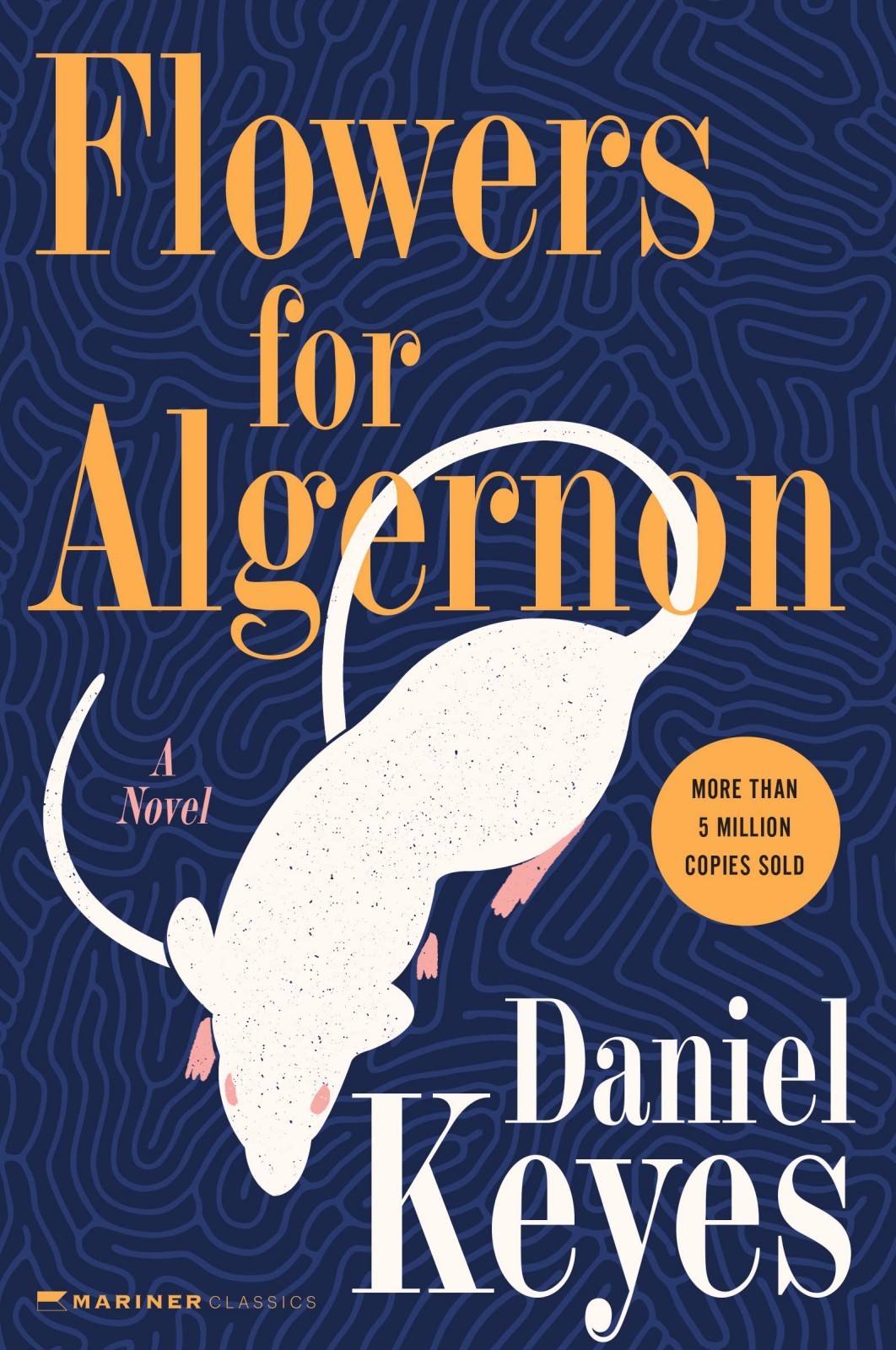
Flowers for Algernon
by Daniel Keyes
Published: 1966
Genre(s): Classics, Science Fiction, Psychology
TLDR:
What happens when a person with a clinically low IQ undergoes a neurological operation to increase their intelligence? Is it safe? Will being smarter give his live meaning? Only time will tell.
From the publisher
Winner of both the Hugo and Nebula Awards, the powerful, classic story about a man who receives an operation that turns him into a genius…and introduces him to heartache.
Charlie Gordon is about to embark upon an unprecedented journey. Born with an unusually low IQ, he has been chosen as the perfect subject for an experimental surgery that researchers hope will increase his intelligence-a procedure that has already been highly successful when tested on a lab mouse named Algernon.As the treatment takes effect, Charlie’s intelligence expands until it surpasses that of the doctors who engineered his metamorphosis. The experiment appears to be a scientific breakthrough of paramount importance, until Algernon suddenly deteriorates. Will the same happen to Charlie?
My Review
There is a reason with a capital R that this book is a classic with a capital C. This book blew me AWAY! I listened to it on audio and wow, did the narrator’s tone reading Charlie’s character change alongside the changes in his intelligence. Yes, some of the linguistic choices and virulent ableism in the world of this book gave me the ick, but I had to keep reminding myself this was written in 1966. Intellectual ableism was RAMPANT – in both directions – there are instances of characters being called “eggheads” and also liberal use of the “R” word.
But all that being said, “Flowers for Algernon” grapples quite successfully and profoundly with questions of what it is to really live a meaningful life and what it takes to be a full person. Is that fullness or realness or meaning determined by psychological testing and evaluations and intellectual capability? Emotional maturity? The ability to relate to others socially? What gives a life meaning? And can a life still be meaningful if it is cut short or if you can’t remember it? In my opinion, this book lands squarely on the side of YES to all of the above. Well, maybe intelligence is overrated by members of the academia. But, really, it’s left open to the reader to interpret their own moral lessons.



 Lydia's Lovely Library
Leave a comment